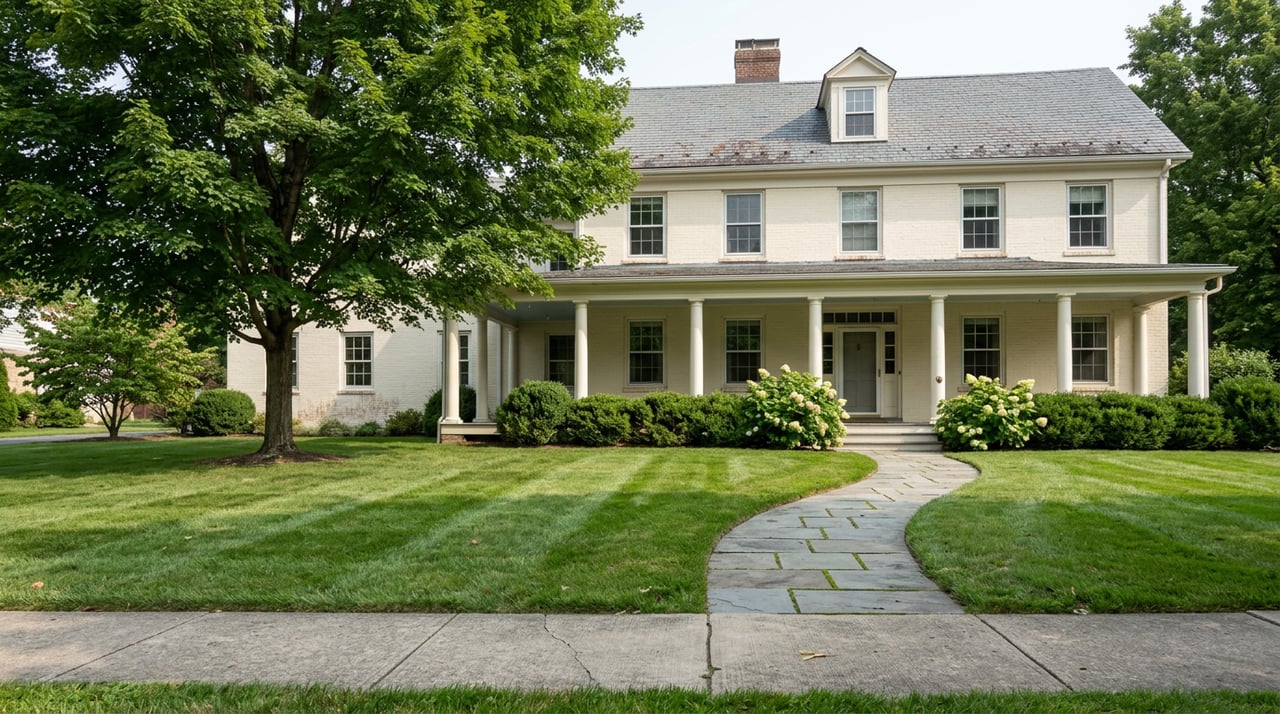
An Ashland Park Lexington Weekend on the Local Loop
August 13, 2026
August 13, 2026
Sunday, 10:50 a.m., and the gravel lot off Sycamore Road is filling with cars, not with tour buses. People cross the lawn carrying rolled mats and folded towels, headed for the shade near the mansion. Nobody stops at the museum store. Nobody buys a ticket. This is the free hour, and if you live in Ashland Park, you probably already know which hour that is.
Search for "Ashland, The Henry Clay Estate" and you'll mostly find the paid version of this place: guided house tours, a wedding venue booking page, holiday events with candlelight in the name. That version is real. It's also not the one your neighbors use most.
Even the internet can't agree on whose neighborhood this landmark belongs to. Wedding vendor sites like Eventective describe the property as sitting in the heart of Chevy Chase. Wikipedia places the same 17 acres in the eastern portion of Ashland Park itself. The neighborhood's own association doesn't bother arguing the point one way or the other; it simply notes that the Ashland Park Historic District sits directly adjacent to Ashland, bounded by Richmond Road, South Hanover Avenue, Fontaine Road, Woodspoint Road, Fincastle Road, and Sycamore Road.
That confusion says something. Outside guides treat the estate as a destination you drive to. People who live on Fincastle or Desha don't need an address resolved because they already walk there.
The paid tours (Signature, Traces: Slavery at Ashland, Women's Voices) cover the mansion's history, including the enslaved workforce that built and ran the estate. Those tours run on a schedule, cost money, and end at the front door. The other calendar starts on the lawn and costs nothing.
Now in its 11th season, Yoga at Ashland runs free, all-levels classes on the grass every Sunday at 11 a.m., a run that kicked off June 21 and continues weekly through October 4, 2026. Bring your own mat or a towel. Nobody checks membership.
"We practice yoga to get good at life."
That's the entire pitch on the sign-up page, and it tracks with how the grounds get used the rest of the week too. Leashed dogs are welcome across the estate's paths and gardens, just not inside the mansion or outbuildings, which makes the lawn one of the few genuinely dog-friendly stretches of green space this close to a historic house museum. Afterward, there's coffee or a plate at Selma's Gingko Tree Café, tucked on the grounds behind the main house, no reservation required.
If you're stepping onto the lawn this month, here's what's actually available without a ticket:
None of that requires a wedding budget or a museum admission. It requires showing up.
The estate isn't the only piece of green space in walking distance, and residents treat it as one stop on a longer circuit rather than a destination in itself. A few streets over, Catalpa Road turns into one of the more photographed stretches in the neighborhood each fall, when its line of ginkgo trees drops its leaves in a matter of days rather than weeks, blanketing the sidewalk in yellow almost overnight. It's not on the estate's property. It's just part of the same tree canopy the neighborhood has been protecting for a century.
Further along, Woodland Park adds a skate park and tennis courts to the mix, along with the summer art fair that draws crowds well beyond the neighborhood. Clay's Spring Park, smaller and easy to miss, marks the site of the natural spring that once supplied the original Clay estate before any of the surrounding streets existed. None of these are secrets exactly. They're just not the version of Ashland Park that shows up when someone Googles the neighborhood from three states away.
The reason this all connects into a walkable loop instead of a scattered list of amenities traces back to a decision made in 1904, when Henry Clay's descendants hired the Olmsted Brothers firm, the same landscape architects behind Central Park, to lay out a residential subdivision on the remaining acreage of the old estate. John C. Olmsted visited the site that year and delivered his full proposal in 1908, calling for curving streets, generous parkways, and triangular greens at the major intersections rather than a standard grid.
Construction moved slowly. The first lots didn't go up for sale until 1919, and building continued for another decade before the neighborhood was substantially complete around 1930, a timeline confirmed by the state historical marker that now stands in the neighborhood. Hanover Avenue was designed as the formal spine of the plan, a broad boulevard with traffic circles that once carried streetcar tracks down its median before cars took over.
That single planning decision, made more than a century ago, is the actual mechanism behind why a Sunday walk here doesn't feel like a chore. There are no long straight blocks to trudge through and no hard right angles forcing you back the way you came. The curves were built to make walking pleasant, and they still do the job they were designed for, whether you're headed to yoga, the dog park loop, or just circling back home before lunch.
That's the part a drive-through visitor misses and a resident doesn't have to think about. The mansion draws the tourists. The streets around it are what make the neighborhood work.
If you're weighing a move into a part of Lexington where the architecture, the tree canopy, and a hundred-year-old design decision still shape how people actually spend a Sunday, Bradford Queen knows this stretch of the Bluegrass block by block. Reach out for a tailored market strategy and white-glove representation.

Every move is unique, and success is measured by both the experience and the outcome. In partnership with Bradford, every detail will be handled with persistence, discretion, and care.
Let's Connect
Bluegrass Sotheby's International Realty 1999 Richmond Road, Suite 400 Lexington, Kentucky 40502