Chevy Chase Lexington Home Prices Beyond the Median
August 20, 2026
August 20, 2026
On May 9, 2026, a home in Chevy Chase sold the way you'd expect a farm or an estate liquidation to sell: at a live, on-site auction. Noel Auctioneers ran the bidding at noon, buyers previewed the property twice beforehand, and the sale closed by the end of June. The listing was upfront about why: the home needed updating, carried some deferred maintenance, and the estate administrator wanted a clean, fast transaction rather than a drawn-out listing process.
That detail should feel strange if the only number you've seen for Chevy Chase is its median price. Trackers pegged the neighborhood's typical value somewhere between $760,000 and $859,000 through the first half of 2026, depending on which source and which month you check. A neighborhood commanding those numbers doesn't sound like a place where sellers need an auctioneer to move a house. But that contradiction is the whole story. Chevy Chase's median price isn't describing one market. It's averaging two.
Walk two blocks in Chevy Chase and you'll cross from one housing product into another, even though the lots look identical from the sidewalk. The neighborhood was platted in the 1920s and 30s in narrow 50 by 150 foot parcels, and most of what got built on them between then and the 1940s was modest by design: Cape Cods, Colonial Revivals, Craftsman bungalows with original hardwood floors, plaster walls, and built-in cabinetry. Those homes, largely untouched, now trade in roughly the $550,000 to $800,000 range.
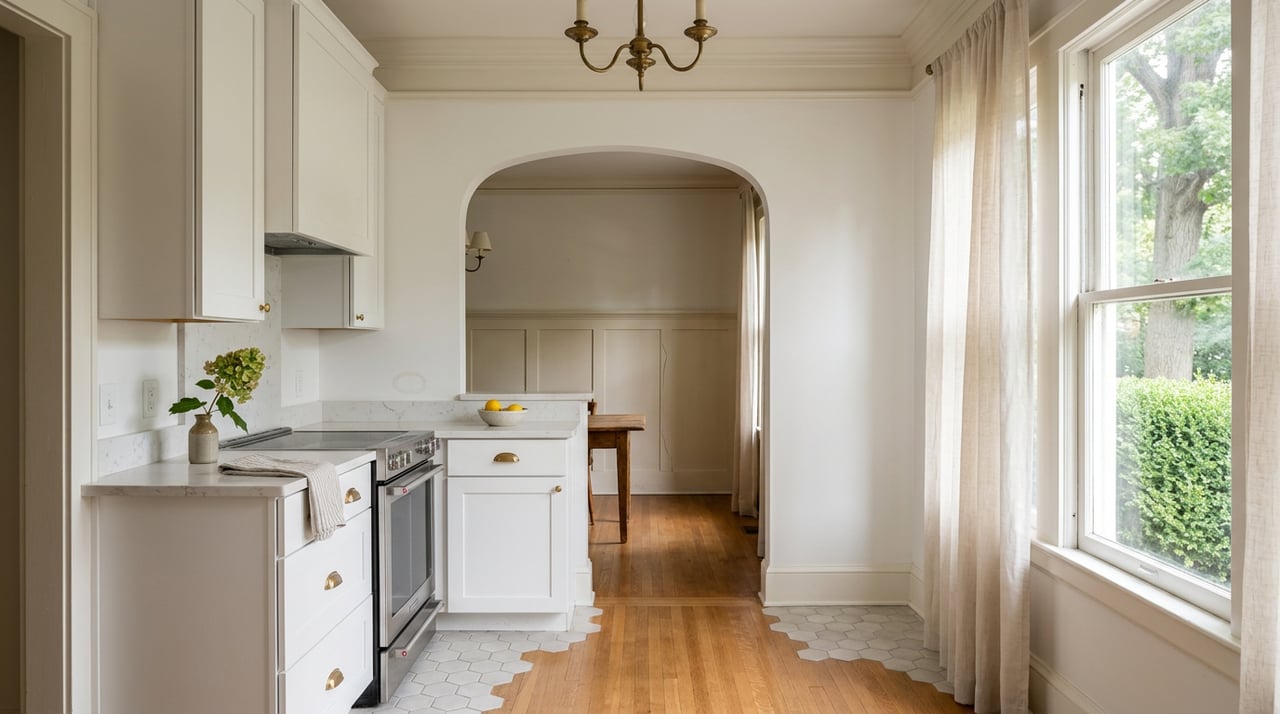
Then there's the other Chevy Chase. Same lots, same eras of construction, but decades of additions layered on top: primary suites pushed into what used to be a side yard, kitchens gutted and rebuilt, basements finished, and in some cases a carriage house or guest suite added behind the main structure. Those homes sell for $800,000 up past $1.2 million.
This is why Zillow's tracked value for the neighborhood sat near $821,000 at the end of June 2026, while Redfin's April 2026 figures put the median sale closer to $859,000, and other aggregators pulling trailing twelve month data landed anywhere from the high $700s to the low $800s. Nobody is wrong. They're just averaging across two different products that happen to share a zip code.
| Classic Chevy Chase | Renovated & Expanded | |
|---|---|---|
| Typical price | $550,000-$800,000 | $800,000-$1.2M+ |
| Era | Built 1920s-1940s | Same era, added onto |
| Lot | 50 x 150 feet | Same 50 x 150 feet |
| What's inside | Original hardwood, plaster walls, older systems | Primary suite additions, modern kitchens, finished basements |
Here's where the median gets genuinely misleading for anyone comparing Chevy Chase against other close-in Lexington neighborhoods. A $760,000 budget in Chevy Chase might land you about 1,800 square feet on a 7,500 square foot lot. The same budget in Hamburg buys 3,000 square feet or more on a quarter acre.
That gap isn't a pricing error. It's the mechanism working exactly as you'd expect once you understand what's actually scarce here. Chevy Chase holds roughly 1,000 homes total inside a quarter square mile footprint, and turnover is low, homes tend to stay in families for decades rather than trading every few years. You can't build more of it. Hamburg can add subdivisions. Chevy Chase cannot add a single additional lot. So a dollar spent on renovation here compounds differently than a dollar spent on renovation somewhere with abundant land, because the location constraint never loosens. That's the actual reason the gap between "classic" and "renovated and expanded" runs so wide: buyers aren't just paying for granite and square footage, they're paying to lock in a location that can't be replicated, and a well-executed renovation on top of that location holds value in a way it wouldn't on a quarter acre lot in a newer subdivision.
Lexington's broader housing market cooled noticeably through the first half of 2026. Citywide days on market climbed to 37 through April 2026, up from the mid-20s a year earlier, a sign that buyers finally have room to think before they sign and sellers who priced for 2024 conditions are sitting on their listings longer than they'd like.
Chevy Chase didn't get that memo. Trackers through the spring and summer of 2026 consistently showed the neighborhood moving in the low to mid 20s for average days on market, with well-prepped homes under roughly $700,000 to $800,000 going under contract in under two weeks. Some listings drew multiple offers with contingencies waived entirely.
That's not a coincidence and it's not stubborn local pride. It's the same scarcity mechanism from the square footage question showing up again, this time in speed instead of price. When a market can expand its supply, cooling demand shows up as more inventory sitting around. When a market can't expand its supply because there are only 1,000 homes and no more land to build on, cooling demand elsewhere in the city barely touches it. The rest of Lexington slowing down doesn't create more Chevy Chase.
That's also why the auction made sense. In a neighborhood where finished, move-in-ready homes are drawing waived contingencies in single-digit days, a property that needs real work doesn't fit neatly into that same fast lane. An estate administrator facing deferred maintenance and an unclear renovation budget for a buyer to absorb has a genuine reason to let a bidding process set the price rather than guess at a list price that might undersell the location or oversell the condition. The auction wasn't a sign of weak demand. It was a sign that Chevy Chase's demand is specific enough that sellers sometimes need a different tool to meet it.
Part of what sustains that demand is showing up in the ground right now. Residents along Romany Road have gone without a full grocery store since the old Kroger there closed, and the replacement has been years in the making. A third Lexington Publix is under construction on the site, developed by Harris Development Partners, sized at roughly 40,000 square feet, nearly double the footprint of the old store but notably smaller than Lexington's other two Publix locations, built with underground parking and elevators to fit the tighter urban lot. A crane arrived in mid-May 2026 to begin installing the facade panels and parking deck structure, a process expected to take seven to eight weeks, part of a build originally estimated at 21 to 25 months from the start of construction.
This isn't the reason people want to live in Chevy Chase. Euclid Avenue's mix of locally owned restaurants and shops, along with the walkability of the whole neighborhood, was already drawing buyers before ground broke on Romany Road. The store is convenience infrastructure catching up to demand that already existed, not a demand driver in its own right. Worth knowing if you're comparing neighborhoods, but not the headline.
If you're cross-shopping Chevy Chase against other Lexington neighborhoods using median price as your yardstick, that number is telling you almost nothing useful about any specific house. Before you compare a Chevy Chase listing to something in another part of town, find out which band it sits in. Ask what's been done to the systems, plumbing, electrical, HVAC, not just the kitchen and bathrooms. A $650,000 classic-condition home and an $850,000 renovated one on the same street might represent the same eventual outcome once you've paid contractors to catch the first one up, just with a different order of operations and a different set of surprises along the way.
Why do different sites list different median prices for Chevy Chase? Because they're pulling different windows of closed sales and weighting a genuinely bimodal inventory differently. A month with more renovated sales pulls the median up. A month with more original-condition sales pulls it down. Neither number is wrong, they're just snapshots of a market that doesn't behave like one consistent product.
Is a lower-priced Chevy Chase listing a red flag? Not inherently. Many of the lower priced homes in the neighborhood are simply original condition, priced for the work they need rather than for the location, which is the same location as the fully renovated home two doors down.
Will the new Publix change prices? It's too early to say, and treating a single store as a price signal would be reading more into it than the evidence supports. What it does address is a convenience gap that residents have been living with for years, which matters for daily life whether or not it shows up in a future sale price.
Chevy Chase rewards buyers and sellers who understand which market they're actually in, not just the one number everyone quotes. If you're trying to figure out where a specific property falls, or you're deciding whether now is the moment to sell a home that's been in your family for decades, Bradford Queen can walk through the specifics with you. Connect for a tailored market strategy and white-glove representation.

Every move is unique, and success is measured by both the experience and the outcome. In partnership with Bradford, every detail will be handled with persistence, discretion, and care.
Let's Connect

Bluegrass Sotheby's International Realty 1999 Richmond Road, Suite 400 Lexington, Kentucky 40502